

Introduction
A vehicle breakdown can turn an ordinary drive through Reynoldsburg, Ohio, into a stressful situation. A flat tire on a busy road, an engine that suddenly overheats, a dead battery in a parking lot, or a vehicle that refuses to start in your driveway can leave you wondering what to do next. Knowing how towing and roadside assistance work can help you make safer decisions, avoid unnecessary delays, and arrange the right kind of help.
Reynoldsburg drivers travel between residential neighborhoods, shopping areas, workplaces, and major routes connecting the eastern Columbus suburbs. Vehicle trouble can happen on a short local trip just as easily as it can during a longer journey. Weather, road conditions, tire problems, battery failures, and mechanical wear can all contribute to unexpected vehicle breakdowns.
Towing and roadside assistance serve related but different purposes. Roadside assistance is generally intended to resolve minor problems where a vehicle is located, while towing transports a vehicle that cannot or should not be driven. Understanding the difference helps drivers explain their situation clearly and request appropriate service.
This guide explains what Reynoldsburg motorists should know about towing options, common roadside emergencies, service costs, vehicle safety, and choosing a dependable provider. It also covers practical steps to take during a breakdown so you can protect yourself, your passengers, and your vehicle while waiting for help.
Understanding Towing and Roadside Assistance
What Is Roadside Assistance?
Roadside assistance is help provided when a vehicle develops a problem that may be resolved without transporting it to another location. Depending on the provider, vehicle, and circumstances, services may include:
Battery jump-starts for vehicles with discharged batteries.
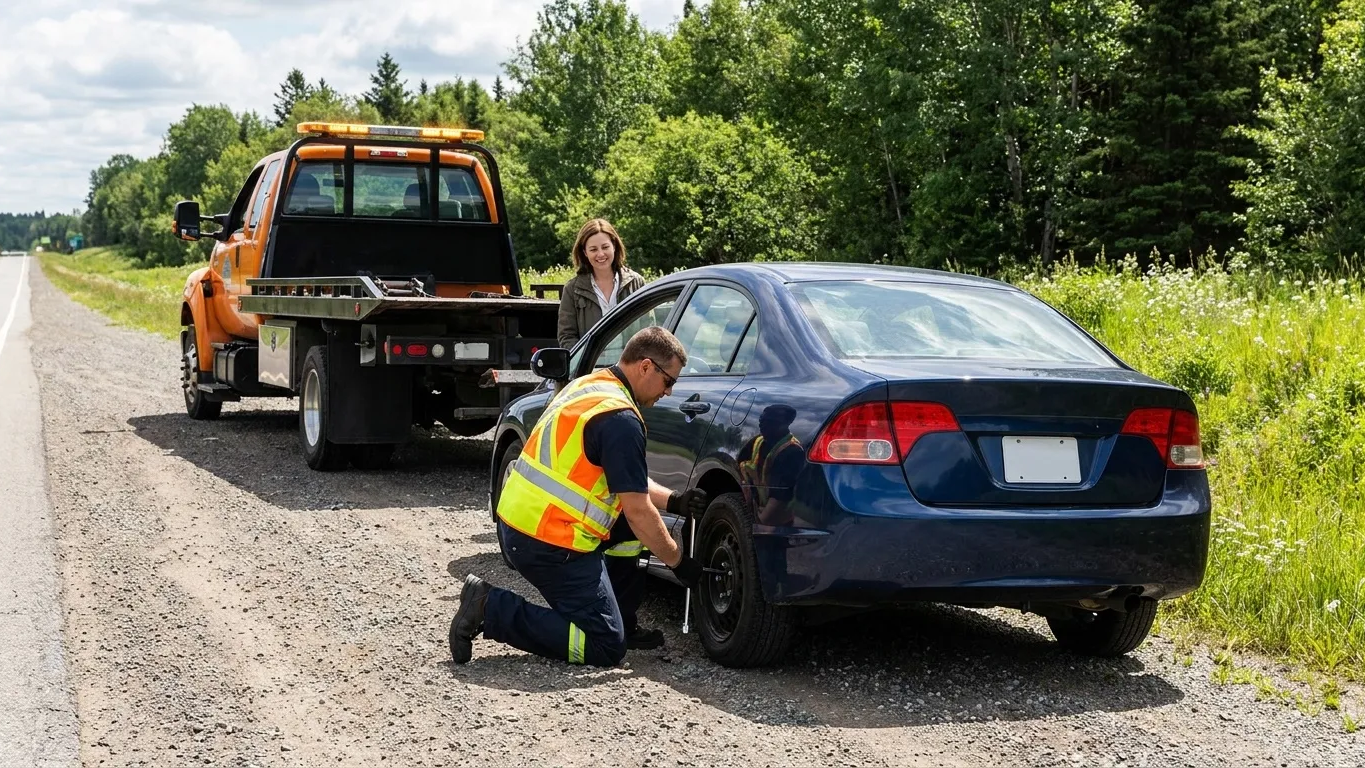
Flat-tire assistance or installation of a usable spare tire.
Vehicle lockout assistance when keys are locked inside.
Emergency fuel delivery when a vehicle runs out of fuel.
Minor assistance intended to help a disabled vehicle become operational again.
The available services depend on the provider's capabilities and the specific situation. A damaged wheel, missing spare tire, unsafe roadside position, or suspected mechanical failure may make a roadside repair impractical.
What Is Towing Service?
Towing involves moving a disabled, damaged, or otherwise inoperable vehicle using suitable towing equipment. A tow may be necessary after a collision, a major mechanical failure, a breakdown that cannot be repaired roadside, or a situation in which driving could cause additional damage.
Depending on the vehicle and circumstances, towing may involve a flatbed truck or another appropriate towing method. The destination might be a repair shop, a residence, a secure storage facility, or another location agreed upon with the service provider.
How Do You Know Which Service You Need?
The simplest distinction is whether the vehicle can be made safe and operational at its current location.
For example, a car that will not start because of a discharged battery may only need a jump-start. If the engine starts but immediately makes unusual noises or displays a serious warning, driving away may not be wise. A vehicle with substantial collision damage will usually require towing rather than an attempted roadside repair.
When you call for assistance, describe the symptoms rather than guessing at the mechanical cause. Explain whether the engine starts, whether the vehicle moves, what warning lights appear, and whether there is visible damage. These details help the provider determine what equipment or service may be appropriate.
Common Reasons Reynoldsburg Drivers Need Towing
Dead Batteries and Starting Problems
A dead battery can leave a vehicle stranded at home, at work, or in a shopping center parking lot. Cold weather, an aging battery, lights left on, and charging-system problems can all contribute to starting difficulties.
A jump-start service may restore power when the battery is discharged and the rest of the starting system is functioning properly. However, repeated starting problems may indicate a failing battery, alternator trouble, damaged connections, or another electrical fault.
If a battery is swollen, leaking, visibly damaged, or suspected of being frozen, do not attempt a jump-start. Request professional assistance and explain what you observed.
Flat Tires and Tire Damage
Punctures, worn tread, road debris, and impact damage can cause a tire to lose pressure or fail completely. A flat tire may be manageable if the vehicle is in a safe location and has a suitable spare, but not every car carries one.
If a tire fails while driving, hold the steering wheel firmly, ease off the accelerator, and move toward a safe stopping location without making sudden movements. Avoid hard braking unless necessary to prevent a collision.
Never change a tire beside fast-moving traffic if the location exposes you to passing vehicles. Roadside assistance or professional tire change services may be the safer choice, particularly if the wheel is damaged or the vehicle cannot be positioned securely.
Engine Overheating and Mechanical Failure
An overheating engine, sudden loss of power, unusual grinding, or a warning light indicating a serious problem may signal a mechanical issue that requires inspection. Continuing to drive can worsen certain faults and increase repair costs.
If the temperature gauge rises into the danger zone or a temperature warning appears, pull over somewhere safe and shut off the engine when appropriate. Never remove a hot radiator cap because pressurized coolant can cause severe burns.
A vehicle that has lost oil pressure, developed a serious steering problem, or experienced brake failure should not be driven to a repair shop. Arrange emergency towing and clearly describe the symptoms to the dispatcher.
Accidents and Vehicles Stuck Off the Road
After a collision, a vehicle may have damaged steering, suspension, tires, lights, or structural components that make it unsafe to drive. Even if it still moves, visible damage does not always reveal the full extent of the problem.
Move to a safe location if possible, check for injuries, and contact emergency services when necessary. Follow the instructions of law enforcement and avoid standing in active traffic lanes.
A vehicle stuck in mud, snow, a ditch, or another difficult position may require specialized vehicle recovery equipment rather than a standard tow. Describe the terrain, the vehicle's position, and any damage when requesting assistance.
What to Do When Your Vehicle Breaks Down
Step 1: Get to a Safer Location
Your first priority is protecting everyone in the vehicle. If the car is still controllable, move out of moving traffic and toward a safe shoulder, parking lot, or nearby designated stopping area.
Turn on the hazard lights. If the vehicle stops in a dangerous location, avoid attempting repairs beside traffic. On a busy road, follow basic breakdown safety tips to remain aware of surrounding vehicles.
Step 2: Assess the Situation Without Taking Risks
Once stopped, determine what you can safely observe. Is there smoke, a burning smell, leaking fluid, a flat tire, or an unusual warning light? Is the vehicle blocking traffic or positioned somewhere that makes loading difficult?
Do not crawl beneath the vehicle, stand behind it in a traffic lane, or touch leaking fluids. If you see flames or substantial smoke, move away from the vehicle and call emergency services.
On limited-access highways, do not assume that standing outside the car is always safer. Follow emergency guidance and choose the safest available position based on traffic, barriers, and the surrounding environment while waiting for emergency towing.
Step 3: Share Accurate Information When Requesting Help
A clear service request can reduce confusion and help the provider prepare for the situation. Be ready to provide:
Your location, nearby cross streets, or a recognizable landmark.
Your vehicle's make, model, approximate size, and color.
A description of the problem and any visible damage.
Whether the vehicle is in a traffic lane, on a shoulder, or in a parking area.
Your destination preference if towing is needed.
Any special requirements, such as all-wheel drive or a vehicle that cannot roll.
If you are unsure of your exact location, use your phone's map application to identify a nearby road or landmark. Do not use your phone while driving to obtain these details.
Step 4: Confirm the Service and Expected Charges
Before authorizing non-emergency work, ask what the provider expects to do and how much it will cost. If the final price depends on distance, vehicle condition, difficult recovery, or additional equipment, ask which circumstances could change the estimate.
Clarify the pickup location, intended destination, payment methods, and whether extra charges may apply. A clear conversation helps prevent misunderstandings when the truck arrives.
Step 5: Prepare for the Tow When It Is Safe
Remove important personal belongings if doing so is safe and permitted. Tell the operator about locked steering, unusual drivetrain requirements, damaged wheels, low ground clearance, or other conditions that could affect loading.
Do not attempt to force a damaged vehicle into neutral or move it if doing so could create additional danger. Follow the operator's instructions and confirm where the vehicle will be delivered.
Choosing the Right Towing Method
Flatbed Towing
A flatbed tow truck carries the vehicle on a platform, with all four wheels typically lifted off the road during transport. This method can be appropriate for collision-damaged vehicles, many all-wheel-drive vehicles, low-clearance cars, and vehicles that should not be driven on their own wheels.
Using flatbed towing can help limit additional road contact during transport. However, the correct loading procedure and equipment still depend on the vehicle's condition, manufacturer instructions, and the recovery situation.
Wheel-Lift Towing
A wheel-lift truck uses a lifting mechanism to raise one end of the vehicle while the other end remains on the road. It can be suitable for certain vehicles and situations when the towing method matches the manufacturer's requirements.
Wheel-lift towing is not automatically appropriate for every car. Drivetrain configuration, transmission design, damage, and vehicle-specific restrictions all matter.
How Should You Choose?
Ask the provider which towing method is appropriate for your vehicle and why. If your vehicle has all-wheel drive, an automatic transmission, substantial collision damage, or a manufacturer-specific towing restriction, mention it before the truck is dispatched.
The cheapest method is not necessarily the most suitable one. Correct equipment, careful loading, and compliance with the vehicle manufacturer's towing instructions should take priority over price alone.
How Much Does Towing Cost in Reynoldsburg, Ohio?
Factors That Affect the Price
Towing and roadside assistance costs vary by provider, vehicle, service type, time, and location. There is no single price that accurately describes every breakdown in Reynoldsburg.
Common pricing factors include:
Distance: The pickup point, destination, and provider's mileage policy can affect the charge.
Service type: A jump-start, tire change, standard tow, and vehicle recovery require different work.
Vehicle size: Larger or heavier vehicles may require specialized equipment.
Vehicle condition: A car with locked wheels, collision damage, or an inability to roll may be more difficult to load.
Recovery conditions: Mud, a ditch, snow, or restricted access can require additional equipment or labor.
Timing: After-hours, holiday, or emergency service pricing may differ by provider.
A short local tow and a long-distance transport should not be expected to cost the same. Likewise, recovering a vehicle from a difficult position may involve charges beyond a basic roadside call.
How to Avoid Unexpected Charges
Ask for an estimate before authorizing service and clarify what the quoted amount includes. Specifically, confirm whether mileage, hookup, recovery work, storage, tolls, or other fees are separate to understand how much towing costs.
If your insurance policy or roadside membership may cover the service, contact the provider or insurer to understand the limits. Some plans require you to use an approved network or obtain authorization before arranging a tow.
Keep the receipt and any written estimate. These records can help if you need to submit a reimbursement request or question a charge later.
What to Look for in a Reliable Towing Provider
Appropriate Equipment and Vehicle Knowledge
A suitable provider should ask questions about your vehicle and the problem rather than treating every call as identical. Equipment needs can differ significantly between a small passenger car, an all-wheel-drive SUV, and a collision-damaged vehicle.
Explain any special requirements before dispatch. Ask whether the operator can safely handle your vehicle and whether another recovery method may be necessary.
Clear Pricing and Communication
A dependable service interaction begins with straightforward information. You should be able to ask about estimated arrival time, the service being provided, expected costs, and the intended destination.
Arrival estimates can change because of traffic, weather, other emergency calls, or the distance of the nearest available truck. Ask for an update if circumstances change, and be cautious about treating an estimate as a guaranteed arrival time.
Service Availability and Local Coverage
Before relying on a provider, verify whether it serves Reynoldsburg and the specific location where your vehicle is stranded. Coverage can vary across city limits and nearby communities.
If you need help late at night, on a weekend, or during severe weather, confirm that 24/7 towing services are currently available. A business advertising emergency assistance may still have different response times depending on demand and truck availability.
Reviews, Credentials, and Documentation
Read recent customer reviews for useful patterns involving communication, billing, vehicle handling, and problem resolution. A single review rarely tells the whole story, so consider the overall evidence.
Ask for the business's identifying information, a service receipt, and any documentation relevant to your situation. For a vehicle involved in a collision, follow instructions from law enforcement, your insurer, and the applicable storage or repair facility before deciding where it should go.
Preparing Your Vehicle for Future Roadside Emergencies
Keep Essential Items in the Vehicle
A small emergency kit can make an unexpected stop easier to manage. Consider carrying a phone charger, flashlight, reflective vest, basic first-aid supplies, drinking water, and seasonal supplies appropriate for your trip.
A properly maintained spare tire and compatible tools may also help, if your vehicle is equipped for a safe tire change. Review your owner's manual so you understand the vehicle's approved lifting points and emergency procedures.
Do not keep emergency supplies in a location that prevents you from reaching them safely or that could become hazardous during a collision.
Maintain the Battery, Tires, and Fluids
Routine maintenance reduces some preventable breakdowns, although it cannot eliminate every risk. Have the battery and charging system checked if starting becomes sluggish or electrical problems recur.
Check tire pressure when the tires are cold and follow the pressure listed on the vehicle's placard, commonly located on the driver's door area. Inspect tread and visible damage regularly, and arrange professional evaluation when a tire shows unusual wear or repeated pressure loss.
Follow the manufacturer's maintenance schedule for engine oil, coolant, transmission service, and other vehicle systems. Address warning lights and new noises promptly rather than waiting until the vehicle becomes undrivable.
Adjust for Ohio Weather
Seasonal weather can create additional demands on a vehicle. Cold temperatures can reduce available battery performance, while snow and ice can make stopping and roadside access more difficult. Heavy rain can reduce visibility and traction.
Before traveling in poor weather, check local conditions, allow extra stopping distance, and avoid unnecessary trips when conditions become hazardous. Keep the fuel level appropriate for the journey and make sure your phone is charged.
If severe weather forces you to stop, prioritize shelter and personal safety over attempting an improvised repair.
Common Misconceptions About Towing and Roadside Assistance
“If the Engine Starts, the Car Is Safe to Drive”
An engine that starts does not prove that the brakes, steering, tires, transmission, or cooling system are safe. A vehicle may still have a serious fault that becomes worse when driven.
If the car has a critical warning, substantial damage, a fluid leak, or abnormal handling, seek professional guidance before moving it.
“Roadside Assistance Always Includes a Free Tow”
Coverage depends on the roadside plan, insurance policy, membership, or provider. Some plans include towing up to a mileage limit, while others reimburse certain expenses or charge separately for additional distance.
Check the terms before assuming a service is included. Ask whether you must obtain approval or use a particular provider to qualify for coverage.
“Any Tow Truck Can Tow Any Vehicle the Same Way”
Vehicles differ in weight, drivetrain, ground clearance, transmission design, and manufacturer restrictions. Improper towing can damage components or make an already unsafe situation worse.
Share the vehicle details before dispatch and let the operator determine the suitable equipment and procedure.
“The Lowest Quote Is Always the Best Choice”
Price matters, but the quote should be considered alongside equipment suitability, communication, and the provider's explanation of the work. A low initial estimate may not include every charge associated with a complicated recovery.
Ask clear questions, compare the complete estimates when time permits, and avoid authorizing work you do not understand.
Local Considerations for Reynoldsburg Drivers
Reynoldsburg is part of the greater Columbus area, where drivers may encounter a mix of residential streets, shopping-center parking lots, busy commuter routes, and roads connecting nearby communities. The safest response to a breakdown depends partly on where the vehicle stops.
A car that fails in a parking lot may be easier to access than one disabled beside moving traffic. A vehicle with a flat tire on a narrow shoulder may need immediate professional assistance rather than an attempt to change the tire.
When requesting towing in Reynoldsburg, give the most precise location you can safely provide. Mention nearby intersections, the direction of travel, a parking-lot entrance, or a visible landmark. If the vehicle is blocking traffic or there is an immediate safety hazard, contact emergency services first.
Drivers traveling toward Columbus or neighboring communities should also confirm that their chosen provider can transport the vehicle to the desired repair facility. A provider's general service area does not necessarily mean every destination or recovery situation is covered under the same terms.
Conclusion
Knowing how towing and roadside assistance work can make an unexpected vehicle problem easier to manage. For Reynoldsburg drivers, the most important steps are to reach a safe location, recognize when a vehicle should not be driven, communicate the problem clearly, and confirm service details before authorizing work.
Roadside assistance may be sufficient for a dead battery, a suitable spare-tire installation, or certain minor problems. Mechanical failures, collision damage, unsafe driving conditions, and difficult vehicle recovery may require towing with the appropriate equipment.
Preparation also makes a difference. Regular maintenance, an emergency kit, a charged phone, and an understanding of your roadside coverage can help you respond more confidently when something goes wrong.
If your vehicle becomes disabled in Reynoldsburg, focus first on personal safety. Then contact us or reach out to a suitable towing provider, explain your location and vehicle condition, and ask about the expected service and cost. A careful, informed decision can help protect both you and your vehicle during a stressful roadside emergency.
Frequently Asked Questions
1. What towing services are available in Reynoldsburg, Ohio?
Towing services may include local vehicle towing, accident recovery, flatbed towing, light-duty towing, and vehicle recovery. Availability depends on the provider, vehicle type, equipment, and circumstances. Confirm that the service can handle your specific vehicle and destination before dispatch.
2. Is roadside assistance available 24 hours a day in Reynoldsburg?
Some towing and roadside assistance providers offer 24-hour emergency service, but availability varies. Confirm that a provider is accepting calls when you need help, and ask for an estimated arrival time. Severe weather, traffic, and competing emergency calls may affect response times.
3. What should I do if my car breaks down on a Reynoldsburg road?
Move out of moving traffic if you can do so safely, turn on your hazard lights, and assess the situation without attempting a dangerous roadside repair. Contact emergency services if there is an immediate hazard. Otherwise, provide a towing or roadside assistance provider with your location, vehicle details, and symptoms.
4. How much does towing cost in Reynoldsburg, Ohio?
The price depends on towing distance, vehicle size, equipment requirements, recovery difficulty, and the provider's pricing policies. After-hours service or additional labor may also affect the total. Request an estimate and ask whether mileage, hookup, recovery, and storage charges are included.
5. Should I choose flatbed towing or wheel-lift towing?
The appropriate method depends on your vehicle's drivetrain, condition, ground clearance, and manufacturer instructions. Flatbeds carry vehicles on a platform, while wheel-lift trucks raise one end. Ask the provider which method is suitable for your vehicle and whether special handling is necessary.
6. Can roadside assistance help with a dead battery or flat tire?
Many providers offer jump-starts and assistance with flat tires. A jump-start may help when a battery is discharged, while tire assistance may involve installing a suitable spare. Damaged batteries, unsafe roadside positions, missing spares, or serious wheel damage may require another solution.
7. Does car insurance cover towing and roadside assistance in Ohio?
Coverage depends on your insurance policy and any optional roadside assistance benefits. Some policies cover eligible towing or roadside services up to specified limits, while others do not include them. Review your policy, ask about mileage restrictions, and confirm whether authorization is required before arranging service.
8. How long does it take for a tow truck to arrive?
Arrival times vary with the provider's location, truck availability, traffic, weather, and current service demand. Give the dispatcher an accurate pickup location and ask for an estimated arrival window. If your situation becomes more dangerous while waiting, contact emergency services rather than relying on the original estimate.
9. Can I request a tow if my vehicle is damaged after an accident?
Yes, towing may be necessary when collision damage makes a vehicle unsafe or impossible to drive. Tell the provider about damaged wheels, leaking fluids, steering problems, or other visible issues. Follow emergency responders' instructions and check with your insurer before choosing a destination if insurance arrangements may affect the process.
10. What information should I provide when requesting roadside assistance?
Provide your exact location or nearby landmark, vehicle make and model, a description of the problem, and whether the vehicle can move safely. Mention special requirements such as all-wheel drive, collision damage, or locked wheels. If you need towing, explain your preferred destination and ask about the estimated cost before authorizing service.
