Running Out of Gas vs. a Mechanical Breakdown: How to Tell the Difference
Introduction
Few roadside problems are more confusing than a vehicle that suddenly loses power or refuses to start. You may assume the fuel tank is empty, but the same symptoms can happen when a battery fails, the fuel system develops a problem, the engine overheats, or another mechanical component stops working.
Knowing the difference between running out of gas and a mechanical breakdown can help you choose the right type of roadside assistance and avoid making the situation worse. A vehicle that simply needs fuel may be back on the road after a fuel delivery, while a serious mechanical problem may require emergency towing to a repair facility.
The challenge is that drivers are rarely trained to diagnose vehicle problems on the shoulder of a road. You do not need to become a mechanic to recognize useful warning signs, though. Paying attention to what happened immediately before the vehicle stopped, what the dashboard is showing, and how the engine behaves can provide valuable clues.
This guide explains the differences between an empty fuel tank and a mechanical breakdown, what symptoms to look for, what to do when you are unsure, and when calling a towing or roadside assistance provider is the safest choice.
What Is the Difference Between Running Out of Gas and a Mechanical Breakdown?
Running out of gas means the vehicle has exhausted its usable fuel supply. A mechanical breakdown means a vehicle has become disabled because a component or system is no longer functioning properly.
The two situations can feel very similar from the driver's seat because both can leave you unable to continue driving. The difference is what caused the vehicle to stop.
If your fuel tank is empty, adding the correct fuel may solve the immediate problem. If the vehicle has an engine, transmission, electrical, cooling, or fuel-system problem, adding gasoline will not correct the underlying issue.
What Happens When a Vehicle Runs Out of Gas?
A gasoline-powered vehicle needs fuel, air, ignition, and proper engine operation to keep running. Once the fuel supply is depleted, the engine can no longer continue producing power.
A vehicle running out of gas may show warning signs before stopping. The fuel gauge may already be near empty, the engine may begin losing power, or the vehicle may hesitate as the remaining fuel becomes insufficient.
After the engine stops, attempting to restart it repeatedly will not solve the problem if there is no fuel available.
What Is a Mechanical Breakdown?
A mechanical breakdown occurs when a vehicle component or system fails enough to prevent normal operation.
Mechanical problems can involve many parts of a vehicle, including:
Engine components
Transmission
Alternator
Starter
Cooling system
Fuel system
Electrical system
Belts and hoses
Steering or suspension components
Drivetrain components
Some breakdowns happen without much warning. Others are preceded by noises, warning lights, overheating, unusual smells, fluid leaks, or changes in how the vehicle drives.
Signs You May Have Run Out of Gas
There are several clues that can point toward an empty fuel tank rather than a major mechanical failure.
The Fuel Gauge Is at or Near Empty
The most obvious clue is a fuel gauge that was already showing empty or nearly empty before the vehicle stopped.
Do not rely exclusively on the gauge, however. Fuel gauges are not perfect, and the amount of usable fuel can vary depending on the vehicle and driving conditions.
The Engine Loses Power Gradually
A vehicle that runs out of fuel may begin to lose power rather than stopping instantly.
You might notice:
Hesitation during acceleration
Sputtering
Reduced engine power
Difficulty maintaining speed
The engine cutting out shortly afterward
If these symptoms occur when the fuel level is very low, an empty tank becomes a reasonable possibility.
The Vehicle Restarts Briefly but Does Not Stay Running
A vehicle that is almost completely out of fuel may start momentarily and then stall again.
Repeated starting attempts are not useful if the tank is empty. Continuing to cycle the starter can also place unnecessary strain on the vehicle's battery.
There Are No Other Obvious Warning Signs
If the vehicle stopped without overheating, smoke, unusual mechanical noise, dashboard warnings, or other concerning symptoms, a fuel shortage may be more likely.
That does not prove the vehicle simply ran out of gas. It is only one clue to consider alongside the other symptoms.
Signs You May Be Dealing With a Mechanical Breakdown
Mechanical problems can produce symptoms that look similar to an empty fuel tank. Several clues can help separate the two.
The Engine Cranks but Will Not Start
If you turn the key or press the start button and hear the engine cranking, but it does not actually start, the problem may involve fuel delivery, ignition, sensors, electrical components, or another system.
An empty fuel tank is one possibility, but it is not the only explanation.
You Hear Clicking Instead of the Engine Turning Over
Repeated clicking when you try to start the vehicle can point toward a weak battery, poor electrical connection, or starter-related problem. Learn more about this by reading our guide on dead battery jump start service.
This is different from an engine that cranks normally but refuses to start.
The Vehicle Overheated Before Stopping
An overheating engine is a strong reason to stop driving and allow the vehicle to cool. Continuing to operate an overheating vehicle can potentially cause additional damage.
If the temperature gauge moved into the hot range, a warning appeared, or steam came from under the hood, treat the situation as a mechanical problem rather than assuming you are out of fuel.
You Notice Smoke, Burning Smells, or Fluid Leaks
Smoke, strong burning odors, or visible fluid leaking from the vehicle can indicate a problem that fuel delivery will not fix.
Do not crawl underneath a disabled vehicle on the roadside to investigate a leak. If the vehicle is in an unsafe location, focus first on getting yourself away from traffic.
Warning Lights Appear
Dashboard warning lights can provide useful information about a developing problem.
An illuminated check-engine light does not automatically mean the vehicle needs a tow. However, if a warning light appears together with severe loss of power, overheating, strange noises, or other serious symptoms, continuing to drive may not be appropriate.
Running Out of Gas vs. Mechanical Breakdown: A Quick Comparison
The easiest way to understand the difference is to compare the symptoms.
Running out of gas commonly involves:
Very low or empty fuel gauge
Sputtering or hesitation before stopping
Gradual loss of power
No major mechanical noises
No obvious overheating
Engine stops because fuel is unavailable
Mechanical breakdowns may involve:
Strange noises
Overheating
Smoke or burning smells
Fluid leaks
Warning lights
Repeated clicking
Engine cranking without starting
Sudden loss of power unrelated to fuel level
Steering, braking, or transmission problems
These signs are clues, not a guaranteed diagnosis. Modern vehicles have complex electrical and mechanical systems, and several different failures can produce similar symptoms.
What to Do If You Are Not Sure Why Your Car Stopped
You do not need to diagnose the vehicle yourself before requesting assistance.
Step 1: Move to a Safe Location If Possible
If the vehicle is still moving and you can safely reach the shoulder, parking lot, or another safe area, move away from active traffic.
If the vehicle has stopped in a dangerous position, turn on your hazard lights and prioritize your personal safety.
Step 2: Turn Off the Engine
If the engine is overheating, smoking, or showing signs of a serious problem, avoid repeatedly trying to restart it.
For a suspected fuel shortage, repeated starting attempts also provide little benefit until fuel is available.
Step 3: Check the Obvious Information
From a safe position, consider:
What did the fuel gauge show?
Did the vehicle sputter before stopping?
Were any warning lights illuminated?
Did the temperature gauge rise?
Did you hear unusual sounds?
Did you notice smoke or a burning smell?
Did the vehicle lose power suddenly or gradually?
You can give this information to the roadside assistance provider.
Step 4: Do Not Guess at a Repair
It can be tempting to start disconnecting components or opening mechanical systems when you are stranded.
That is rarely a good idea beside a busy roadway. If you are not trained to diagnose the problem safely, professional roadside assistance or towing is the better option.
Step 5: Request the Appropriate Help
If you are confident that the vehicle ran out of fuel, fuel delivery may solve the immediate problem.
If the vehicle has a mechanical problem or you cannot determine what went wrong, towing may be necessary. A roadside assistance provider can assess the situation and determine whether an on-site service or vehicle transport is appropriate.
Can Roadside Assistance Help With Both Problems?
Yes. Roadside assistance is designed to address several common vehicle emergencies, including situations involving fuel shortages and disabled vehicles.
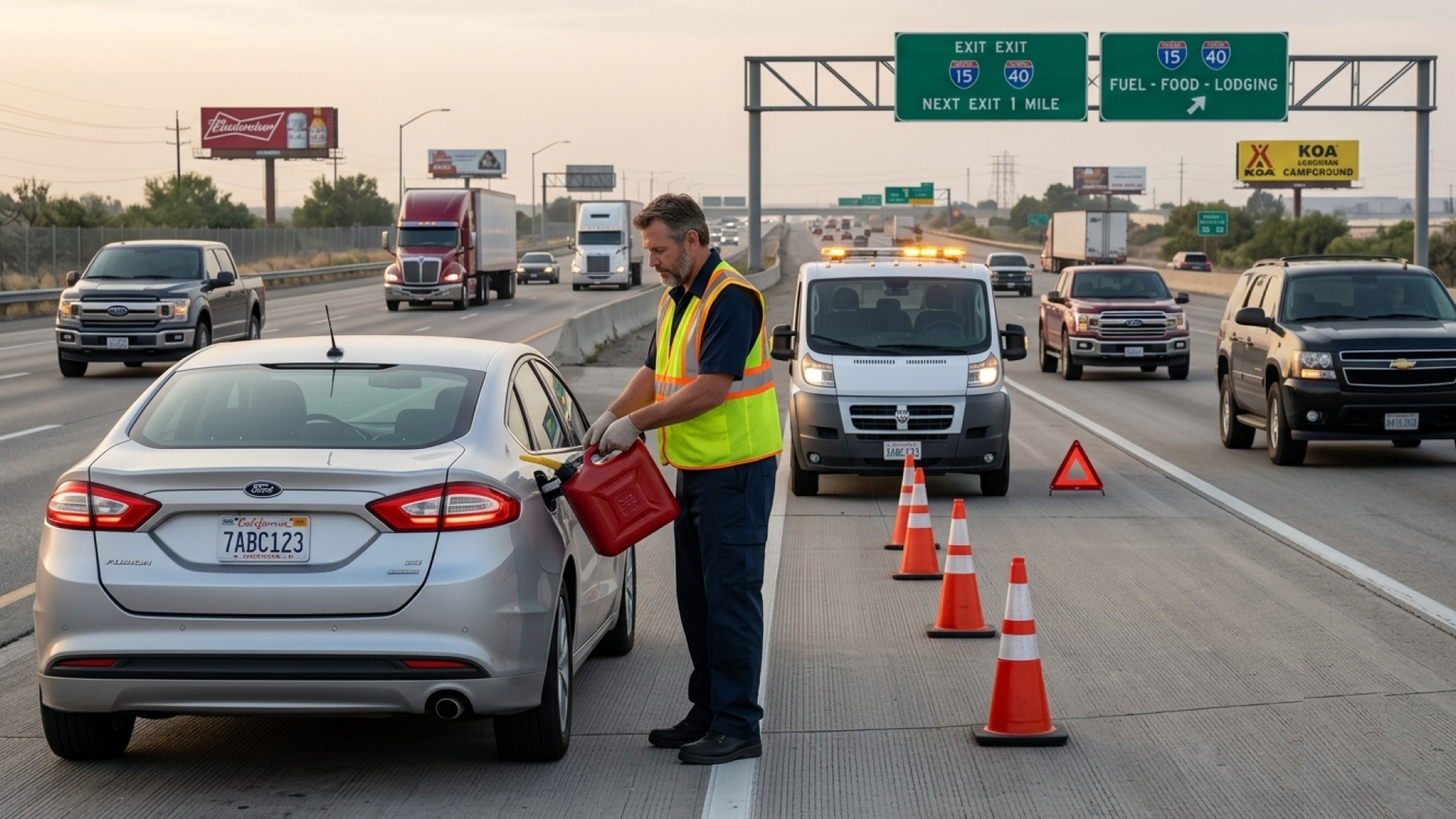
Fuel delivery can help when a driver runs out of gasoline. Other roadside services may include jump starts, tire changes, lockout assistance, and towing when the problem cannot be resolved safely at the roadside.
The appropriate service depends on what has happened to the vehicle. Current service information for the provided website includes fuel delivery, jump starts, tire changes, roadside assistance, emergency towing, flatbed towing, vehicle recovery, and accident recovery.
When Fuel Delivery May Be Enough
Fuel delivery may be appropriate when:
The vehicle ran out of fuel
There are no signs of a separate mechanical problem
The vehicle is parked safely
The correct fuel can be delivered
The vehicle is expected to operate normally after refueling
Even after receiving fuel, pay attention to how the vehicle behaves. If it still will not start or continues to run poorly, another problem may be present.
When Towing Is More Appropriate
Towing may be necessary when:
The engine has a serious mechanical problem
The vehicle overheated
The transmission is not functioning
The vehicle has significant electrical problems
The vehicle was involved in an accident
The vehicle cannot safely be driven
The cause of the breakdown is unknown
Continuing to drive could increase the risk of damage
A disabled vehicle does not have to be completely destroyed to require towing. Sometimes the safest decision is simply to transport it to a qualified repair facility for diagnosis.
Common Mistakes Drivers Make After a Vehicle Stops
Repeatedly Trying to Start the Engine
If the vehicle is out of fuel or has a serious mechanical problem, repeated starting attempts are unlikely to solve the issue.
If you hear unusual noises, smell something burning, or see warning signs, stop attempting to start the vehicle and seek assistance.
Assuming Every No-Start Problem Means a Dead Battery
A vehicle that will not start can have many possible causes. A dead battery is common, but it is not the only explanation.
Fuel delivery problems, starter issues, ignition problems, and other mechanical or electrical failures can produce similar symptoms.
Continuing to Drive an Overheating Vehicle
If the temperature gauge is extremely high or the vehicle is producing steam, continuing to drive can turn a manageable problem into a much more serious repair.
Pull over safely and seek assistance instead of trying to reach the next exit or repair shop at all costs.
Standing Beside the Vehicle in A Dangerous Location
A disabled vehicle can become a safety hazard, particularly on a highway or heavily traveled road.
Use hazard lights when appropriate, move to a safe location if you can do so without putting yourself at risk, and avoid standing in active traffic lanes.
How to Explain the Problem to a Towing Company
When requesting towing or roadside assistance, the information you provide can help the dispatcher understand what type of assistance may be needed.
Tell them:
Your exact location or nearest recognizable landmark.
Your vehicle's make, model, and approximate year.
Whether the vehicle is on the shoulder, in a parking lot, or blocking traffic.
What happened immediately before it stopped.
What the fuel gauge shows.
Whether the engine cranks or only clicks.
Whether you noticed smoke, leaks, unusual sounds, or overheating.
Whether the vehicle can move under its own power.
Any special vehicle considerations that may affect towing.
If you simply say, "My car won't start," the provider may have limited information. Explaining the symptoms gives them a much clearer picture of the situation.
How to Prevent Running Out of Gas
Running out of fuel is often preventable with a few simple habits.
Refuel Before the Tank Is Nearly Empty
Do not make a habit of driving until the fuel warning appears every time. Traffic, detours, weather, and unexpected delays can increase the amount of time you spend on the road.
Keeping a reasonable fuel reserve can reduce the risk of becoming stranded.
Pay Attention to Your Driving Range
Your vehicle's estimated range can be useful, but it should not be treated as an exact guarantee. Conditions such as traffic, speed, weather, terrain, and driving habits can affect fuel consumption.
Know Where Fuel Stations Are Along Longer Trips
Before a long drive, identify fuel stops along the route. This is especially useful when traveling through areas where stations may be farther apart.
How to Reduce the Risk of Mechanical Breakdowns
Mechanical failures cannot always be predicted, but regular maintenance can help identify developing problems.
Follow the manufacturer's maintenance schedule and pay attention to changes in vehicle behavior.
Warning signs worth investigating include:
New or unusual engine noises
Repeated warning lights
Fluid spots beneath the vehicle
Difficulty starting
Overheating
Shaking or vibration
Changes in transmission behavior
Unusual smells
Changes in braking or steering
A small issue can sometimes be easier to address before it leaves you stranded.
What If Your Vehicle Stops in Heavy Traffic?
A breakdown in moving traffic requires extra caution.
Turn on your hazard lights and, if the vehicle can be moved safely, get as far away from active traffic as possible. Do not attempt repairs in a travel lane.
If you cannot move the vehicle, remain aware of surrounding traffic and contact appropriate roadside assistance. Give the dispatcher precise information about your location and which direction you are traveling.
The goal is not to diagnose the car beside the road. The first priority is creating a safer situation for you, your passengers, and other motorists.
When a Simple Fuel Problem Becomes a Towing Situation
Sometimes a driver assumes the vehicle only needs gas, but the vehicle still will not operate after refueling.
If you receive fuel and the engine continues not to start, there may be another problem. Similarly, if the vehicle starts but immediately stalls, runs poorly, overheats, or produces unusual noises, it should not automatically be considered fixed.
At that point, professional roadside assistance or towing can help determine the next step.
A towing provider may transport the vehicle to a repair shop, dealership, or another appropriate destination when driving it is unsafe or impossible.
Conclusion
Running out of gas and experiencing a mechanical breakdown can feel almost identical when you are sitting in a disabled vehicle. The difference usually becomes clearer when you look at the symptoms that appeared before the vehicle stopped.
A nearly empty fuel gauge combined with sputtering and gradual power loss may point toward an empty tank. Overheating, unusual noises, warning lights, smoke, fluid leaks, repeated clicking, or an engine that cranks without starting can point toward a mechanical or electrical problem.
You do not need to make a perfect diagnosis on the roadside. Get yourself to a safe location if possible, avoid risky repairs, describe the symptoms clearly, and request fuel delivery, roadside assistance, or towing based on the situation.
When there is any doubt about whether a vehicle is safe to drive, having it professionally assessed or transported can be safer than trying to force the trip to continue.
Frequently Asked Questions
What are the signs that a car has run out of gas?
Common signs include a fuel gauge near empty, sputtering, hesitation, gradual loss of engine power, and the engine eventually stopping. If adding the correct fuel does not restore normal operation, another problem may be responsible.
How can I tell if my car has a mechanical problem instead of being out of gas?
Look for symptoms such as overheating, unusual noises, warning lights, smoke, fluid leaks, burning smells, repeated clicking, or an engine that cranks but does not start. These signs can indicate a mechanical or electrical issue.
Can a car run out of gas even when the fuel gauge shows some fuel?
Yes. A fuel gauge is an estimate rather than a precise measurement of usable fuel. If your vehicle begins sputtering or loses power while the gauge is very low, running out of fuel is still possible.
What should I do if my car stops running while I am driving?
If possible, move the vehicle to a safe location away from traffic, turn on your hazard lights, and avoid standing in a travel lane. Contact roadside assistance or towing if the vehicle cannot safely continue.
Can roadside assistance deliver fuel if I run out of gas?
Fuel delivery is a common roadside assistance service. A provider can bring fuel to a stranded driver so the vehicle can potentially be restarted without requiring a tow, provided there is no separate mechanical problem.
What if my car still will not start after adding gas?
If the vehicle remains unable to start after receiving fuel, do not assume that more fuel will solve the problem. The vehicle may have a battery, starter, ignition, fuel-system, electrical, or mechanical issue that requires professional diagnosis.
Should I drive my car if it is overheating?
A vehicle that is seriously overheating should generally not be driven until the cause has been addressed. Continuing to operate an overheating engine can increase the risk of additional damage. Pull over safely and seek professional assistance.
Can a dead battery feel like running out of gas?
It can create confusion because both situations can leave you unable to start the vehicle. A battery problem often produces clicking or weak cranking, while an empty-fuel situation may involve normal cranking without the engine starting.
How much does towing or roadside assistance cost in Ohio?
The price depends on factors such as the type of service, vehicle, location, distance, and circumstances of the call. Fuel delivery may have a different cost from towing, while specialized recovery or longer-distance transportation can involve additional charges.
When should I call a tow truck instead of trying to drive home?
Call for towing when the vehicle is unsafe or impossible to drive, has serious mechanical symptoms, has been involved in an accident, is overheating, has significant damage, or you are uncertain whether it can safely continue. Transporting the vehicle can prevent additional risk or damage.