Introduction
When a vehicle needs to be towed, the type of tow truck used can make a real difference. Two of the most common options are flatbed towing and traditional towing, sometimes called wheel-lift or hook-and-chain-style towing. While both methods are designed to transport disabled vehicles, they work differently and are suited to different situations.
For many drivers, the decision is not simply about choosing the cheapest tow. Factors such as the vehicle's drivetrain, condition, ground clearance, location, accident damage, and distance of transport can affect which towing method makes the most sense.
Flatbed towing places the vehicle entirely on a level platform, keeping all four wheels off the road during transportation. Traditional towing generally lifts one end of the vehicle while the other wheels remain on the ground. Modern wheel-lift systems are more controlled than older hook-and-chain equipment, but they still involve a different towing setup.
Understanding these differences can help you make a better decision when your car breaks down, is involved in an accident, or needs to be transported to a repair facility. Casper Towing Ohio provides towing and roadside assistance services, including flatbed towing, emergency towing, vehicle recovery, and accident recovery for drivers in its service area.
What Is Flatbed Towing?
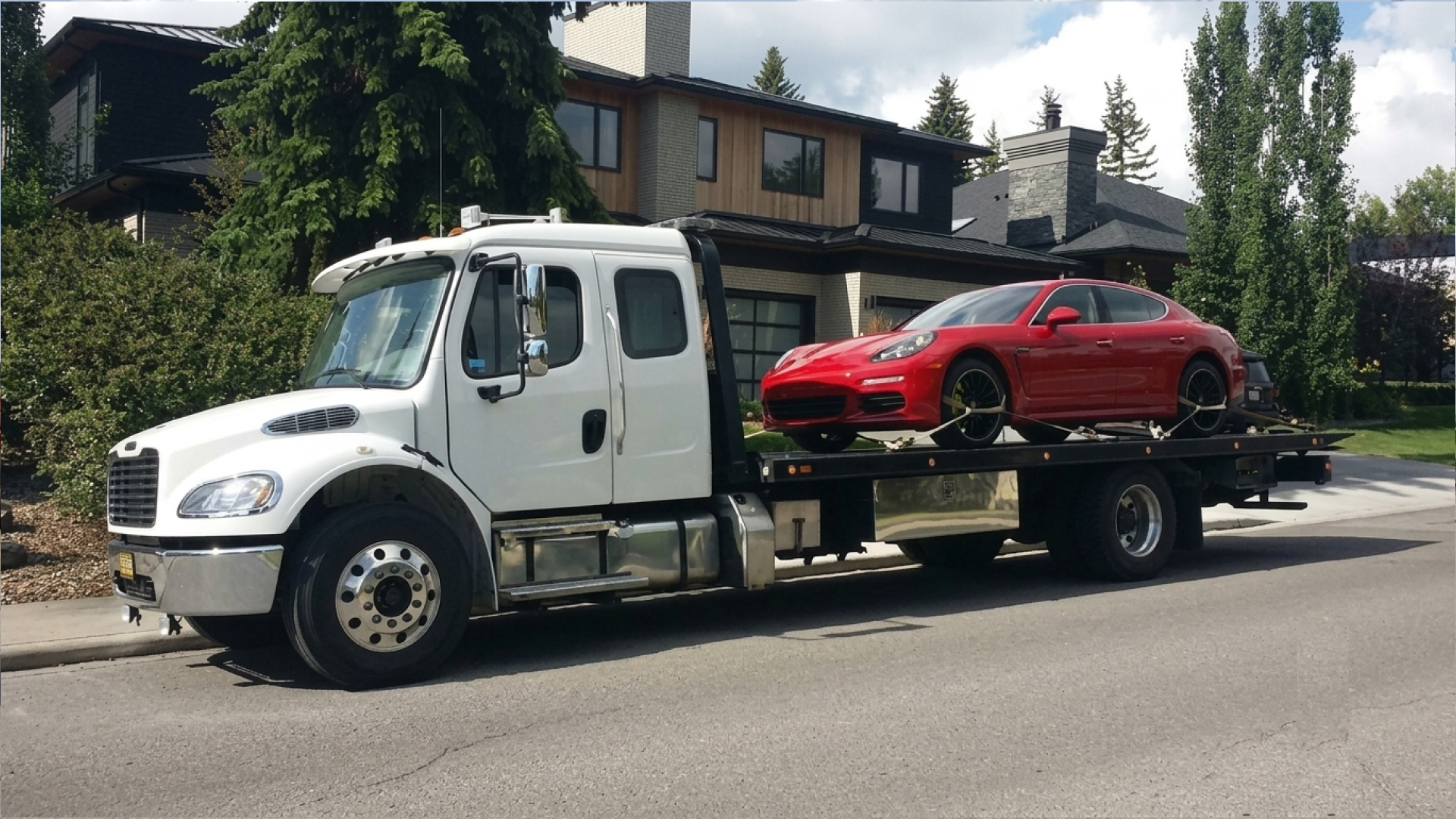
Flatbed towing uses a tow truck equipped with a long, flat platform. The vehicle being transported is loaded onto that platform, so its tires remain completely off the ground throughout the trip.
Depending on the vehicle's condition, the tow operator may drive it onto the bed or use a winch to pull it into position. Once loaded, the vehicle is secured using appropriate tie-down equipment before transportation begins.
Because the entire vehicle rests on the truck, flatbed towing provides a different level of separation between the disabled vehicle and the roadway. To learn more about this method, check out how professional flatbed towing protects your vehicle during transport.
How Flatbed Towing Works
The basic process usually involves several steps:
The tow truck is positioned in a safe location near the disabled vehicle.
The flatbed platform is lowered or tilted to create a loading angle.
The vehicle is driven or winched onto the platform.
The vehicle is positioned correctly on the bed.
The operator secures the vehicle using appropriate tie-downs.
The platform is returned to its transport position.
The vehicle is transported to the requested destination.
This approach is particularly useful when a vehicle should not be driven or when keeping all four wheels off the road is preferable.
Advantages of Flatbed Towing
Flatbed towing offers several practical benefits.
All four wheels remain off the ground: This eliminates normal road contact during transportation and can be especially useful for vehicles with drivetrain or wheel-related problems.
It works well for many specialty vehicles: Low-clearance vehicles, luxury cars, certain AWD vehicles, and vehicles with extensive damage may benefit from flatbed transportation.
It can reduce additional movement of a damaged vehicle: After an accident, a vehicle may have damaged wheels, suspension components, steering parts, or other systems. Loading it onto a flatbed can make transportation easier when driving the vehicle is not advisable.
It is useful for longer-distance vehicle transportation: Keeping the vehicle fully supported on the carrier can make flatbed towing a practical choice when a vehicle needs to travel beyond the immediate area.
Casper Towing Ohio specifically describes its flatbed towing service as secure vehicle transportation and states that it uses professional flatbed tow trucks and precision tie-downs for vehicles such as AWD, luxury, and low-clearance cars.
What Is Traditional Towing?
Traditional towing is a broader term that can refer to towing methods where the tow truck lifts part of the vehicle while the remaining wheels stay on the road. Modern towing companies commonly use wheel-lift systems, which raise either the front or rear wheels using a specialized lifting mechanism.
Older hook-and-chain towing equipment is less common for everyday passenger vehicles because modern wheel-lift systems provide more controlled vehicle handling.
With a wheel-lift tow, the operator positions the equipment beneath the appropriate part of the vehicle, secures the vehicle, raises one end, and transports it with the other wheels rolling on the road.
How Traditional Wheel-Lift Towing Works
The general process looks like this:
The operator assesses the vehicle and surrounding conditions.
The tow truck is positioned appropriately.
The lifting equipment is placed beneath the vehicle.
The appropriate wheels are secured.
One end of the vehicle is lifted.
The vehicle is transported with the remaining wheels on the roadway.
The exact method depends on the vehicle, its drivetrain, condition, and the towing equipment available.
Advantages of Traditional Towing
Traditional wheel-lift towing can be useful in situations where a full flatbed is not necessary.
Practical for short-distance towing: Especially when a vehicle is disabled but otherwise suitable for this type of transport.
Useful when space is limited: A wheel-lift truck can sometimes access locations where positioning a large flatbed may be more difficult.
Efficient routine towing: For certain routine towing situations, a wheel-lift system can provide an efficient way to move a vehicle without requiring the entire vehicle to sit on a flatbed.
The key is that the towing method should match the vehicle and circumstances rather than assuming one method is always better.
Flatbed Towing vs. Traditional Towing: Key Differences
The biggest difference is simple: flatbed towing transports the entire vehicle on the truck, while traditional wheel-lift towing raises only part of the vehicle.
FeatureFlatbed TowingTraditional Wheel-Lift TowingVehicle positionEntire vehicle sits on the flatbedOne end is liftedWheels on roadwayNoneUsually twoDrivetrain concernsGenerally minimized because wheels are off the groundMust be considered carefullyDamaged vehiclesOften a strong optionDepends on the damageLow-clearance vehiclesOften suitableMay require additional careAWD vehiclesOften preferredRequires proper towing procedureShort-distance towingSuitableOften practicalLonger transportationWell suitedDepends on vehicle and circumstancesLoading methodDrive-on or winchLift and secure wheelsSpace requirementsRequires room for the flatbedCan be more maneuverable in some situations
The table provides a general comparison, but the appropriate towing method should always be determined based on the specific vehicle and circumstances.
When Is Flatbed Towing the Better Choice?
Flatbed towing is often a strong option when the vehicle needs to remain completely off the roadway. For a deeper breakdown of these scenarios, read when is flatbed towing the best choice for your vehicle.
Damaged Vehicles After an Accident
A collision can leave a vehicle with damaged tires, wheels, suspension, steering, or drivetrain components. Attempting to tow such a vehicle with a method that leaves damaged wheels on the ground may create additional complications.
A flatbed can allow the vehicle to be loaded and transported without requiring its wheels to roll during the trip.
Accident recovery should be handled carefully, especially if the vehicle is in a hazardous position or has suffered significant structural damage. The towing operator should assess the situation before deciding how to load it. You can read more about what happens during a professional accident recovery service to see how operators keep your car safe.
All-Wheel-Drive Vehicles
AWD vehicles deserve particular attention because the drivetrain connects power to multiple wheels.
Improper towing can potentially cause drivetrain problems on some vehicles. Manufacturer recommendations vary, so the owner's manual should be checked whenever possible.
A flatbed is often a practical choice because all four wheels remain off the ground during transportation.
Low-Clearance Cars
Sports cars and other low-clearance vehicles can require additional care during loading and transportation.
A tow operator may need to consider the approach angle, ground clearance, and loading conditions. Flatbed equipment can provide a controlled platform for transporting these vehicles and avoiding undercarriage damage—a key part of what is damage-free towing.
Vehicles That Cannot Roll Normally
A vehicle with a seized wheel, damaged axle, severe tire problem, or other mechanical issue may not be able to roll normally.
In these circumstances, the towing operator may need to use a winch or specialized equipment to load the vehicle. A flatbed can be particularly useful because the vehicle does not have to remain fully operational during transport. In complex off-road or ditch scenarios, you might need specialized help—learn how vehicle recovery services help in difficult situations.
When Is Traditional Towing Appropriate?
Traditional wheel-lift towing still has an important place in roadside and towing operations.
Routine Local Towing
If a vehicle has a straightforward mechanical problem and can safely be moved using a wheel-lift system, traditional towing may be a practical option.
For example, a car that will not start but has functioning wheels and no major damage may be suitable for this type of transport, depending on its drivetrain and manufacturer requirements.
Locations With Limited Space
Some roadside situations provide little room for a tow truck to maneuver.
A wheel-lift truck may be easier to position in certain tight spaces, parking areas, alleys, or congested locations. The operator must still have enough room to safely secure and move the vehicle.
Situations Where a Flatbed Is Not Necessary
Not every tow requires the vehicle to sit completely on a carrier.
A professional tow operator can evaluate the vehicle and determine whether a wheel-lift system is appropriate. The goal is safe transportation, not automatically selecting the largest or most expensive towing method.
Is Flatbed Towing Safer Than Traditional Towing?
There is no universal answer that makes one method safer for every vehicle and situation.
Flatbed towing has a significant advantage when keeping all four wheels off the roadway is desirable. This can be especially relevant for AWD vehicles, specialty vehicles, certain accident-damaged cars, and vehicles with wheel or drivetrain concerns.
Traditional wheel-lift towing can also be appropriate when the vehicle is compatible with the equipment and the operator follows the correct towing procedure.
The condition of the vehicle matters just as much as the type of truck. A qualified towing professional should consider the drivetrain, steering, suspension, wheels, tires, ground clearance, and manufacturer's towing recommendations before transporting the vehicle. Understanding these nuances helps clarify the role of professional towing services during unexpected vehicle emergencies.
Common Misconceptions About Flatbed and Traditional Towing
“Flatbed towing is always necessary.” Not necessarily. Flatbeds are extremely versatile, but some vehicles and towing situations can be handled appropriately with wheel-lift equipment.
“Traditional towing is only for old vehicles.” Modern wheel-lift systems are used for many types of vehicles. The deciding factor is whether the vehicle and situation are compatible with the towing method.
“AWD vehicles can always be towed with two wheels on the ground.” This is not a safe assumption. AWD systems vary by vehicle, and manufacturers may specify particular towing procedures. When there is uncertainty, a flatbed is often worth considering, and the vehicle's manual should be consulted.
“A car involved in an accident can simply be driven onto the tow truck.” A collision can damage components that are not immediately obvious. If the vehicle has steering, suspension, wheel, brake, or structural damage, it may not be safe to drive it onto a carrier. The operator should inspect the vehicle and use appropriate loading equipment.
What Should You Tell a Towing Company?
When requesting a tow, providing accurate information can help the dispatcher determine what equipment may be appropriate. Knowing what information should you provide when calling a tow truck saves time and prevents potential delays. Be ready to explain:
Your exact location
Vehicle make, model, and approximate year
Whether the vehicle starts
Whether the wheels roll
Whether the vehicle has AWD or four-wheel drive
Whether the vehicle was involved in an accident
Any visible wheel, tire, suspension, or steering damage
Whether the vehicle is in a garage, parking structure, roadside, or another restricted location
Your intended destination
Photos can also be useful if the towing company asks for them. The more accurately the situation is described, the easier it is to send equipment that matches the job.
What to Do While Waiting for a Tow Truck
Safety should come before the vehicle. Reviewing safety tips for drivers experiencing a breakdown on busy roads is essential while you wait.
If you break down on a busy road, move the vehicle away from traffic if it can be done safely.
Turn on your hazard lights and remain in a safe location rather than standing near moving traffic.
If the vehicle cannot be moved, avoid attempting complicated repairs beside the roadway. Stay alert to passing traffic and follow local roadway safety guidance.
For more step-by-step guidance, check our guide on what to do while waiting for emergency towing service in Columbus, OH.
After an accident, do not attempt to move an injured person unless there is an immediate danger requiring action. Contact the appropriate emergency services when necessary and wait for professional assistance.
How to Choose the Right Towing Method
For most drivers, the decision does not need to be complicated. Ask three basic questions:
Can the vehicle safely roll?
Does the vehicle have drivetrain, wheel, suspension, or accident damage?
Does the manufacturer specify a particular towing method?
If the vehicle has significant damage, AWD, low ground clearance, or cannot roll normally, flatbed towing may be a strong option.
If the vehicle is in relatively straightforward condition and compatible with wheel-lift towing, traditional towing may be appropriate.
A professional towing operator can make the final equipment decision after assessing the vehicle and location.
Flatbed Towing for Ohio Drivers
Ohio drivers can encounter a wide range of roadside situations, from everyday mechanical breakdowns to accident recovery and vehicle transportation. If you run into other minor roadside issues, services like a jump start for a dead battery, a quick tire change for a flat tire, or emergency fuel delivery when running out of gas can get you moving without needing a full tow. You can also explore car lockout assistance in Columbus, OH if your keys are trapped inside.
A towing company serving the Columbus and Central Ohio area may handle services such as emergency towing, flatbed towing, roadside assistance, vehicle recovery, accident recovery, jump starts, tire changes, and fuel delivery. Casper Towing Ohio's website lists these services and identifies Columbus as its primary location, with service areas including Hilliard, Westerville, Reynoldsburg, Dublin, Grove City, Upper Arlington, and Galloway.
Choosing the correct towing method is particularly useful when road conditions, vehicle condition, and transportation distance vary. Drivers should provide as much information as possible when requesting assistance so the appropriate equipment can be dispatched. If you need help right away, feel free to contact us.
Conclusion
Flatbed towing and traditional wheel-lift towing serve the same broad purpose—moving a disabled vehicle safely—but they accomplish it in different ways.
Flatbed towing carries the entire vehicle on a platform, keeping all four wheels off the ground. This makes it a practical choice for many AWD vehicles, low-clearance cars, accident-damaged vehicles, and vehicles that should not roll during transportation.
Traditional wheel-lift towing raises one end of the vehicle, leaving the other wheels on the road. It can be a practical option for compatible vehicles, routine local towing, and situations where a full flatbed is not required.
The best towing method depends on the vehicle, its condition, drivetrain, location, and manufacturer's recommendations. When requesting towing or roadside assistance, give the dispatcher accurate information about the vehicle and what happened.
For Ohio drivers, understanding the difference between flatbed and traditional towing can make an unexpected breakdown less confusing. The right equipment can help ensure that the vehicle is handled appropriately from the roadside to its final destination.
Frequently Asked Questions
What is the difference between flatbed towing and traditional towing?
Flatbed towing places the entire vehicle on a flat platform, so all four wheels are off the ground. Traditional wheel-lift towing raises one end of the vehicle while the other wheels remain on the roadway. The appropriate method depends on the vehicle and towing circumstances.
Is flatbed towing better for AWD vehicles?
Flatbed towing is often a practical choice for AWD vehicles because all four wheels remain off the ground. However, AWD systems differ between vehicles, so drivers should follow the manufacturer's towing instructions and allow the towing professional to assess the vehicle.
Is flatbed towing safer for a damaged car?
It can be a better option for certain damaged vehicles because the vehicle can be transported without requiring its wheels to roll on the roadway. The exact method depends on the type and severity of the damage.
Can a flatbed tow a car that does not start?
Yes. A vehicle does not necessarily need to be running to be loaded onto a flatbed. Depending on its condition, a tow operator can use a winch or other appropriate loading equipment.
Can traditional towing damage a vehicle?
Properly performed wheel-lift towing is designed to transport compatible vehicles safely. Problems can occur when the towing method is unsuitable for the vehicle's drivetrain, condition, or manufacturer's requirements. Professional assessment is important.
Which towing method is better for a low-clearance vehicle?
Flatbed towing is often a practical choice for low-clearance vehicles because the vehicle can be loaded onto a carrier rather than being dragged or rolled behind the truck. Loading still needs to be performed carefully to avoid contact with the roadway or equipment.
Does every accident-damaged vehicle need a flatbed?
No. The appropriate towing method depends on the vehicle's condition and the type of damage. However, a flatbed may be particularly useful when wheels, suspension, steering, drivetrain, or other components are damaged.
What information should I give a towing company when my car breaks down?
Provide your exact location, vehicle make and model, whether it starts or rolls, drivetrain type if known, visible damage, and the reason you need a tow. Mention whether the vehicle is in a parking garage, roadside, or another difficult-access location.
How much does towing usually cost in Ohio?
Towing prices vary based on factors such as location, vehicle type, distance, towing method, and the specific service required. Read more on how much does towing cost in Columbus, OH for details. A reliable provider should explain applicable charges before the service is performed. The Casper Towing Ohio website states that pricing depends on the vehicle, location, and service needed and that it provides an upfront quote.
What should I do if my car breaks down on the side of the road?
Move the vehicle away from traffic if you can do so safely, turn on your hazard lights, and remain in a safe location. Contact a towing or roadside assistance provider and clearly explain your location and vehicle condition. If the breakdown creates an immediate safety hazard, contact emergency services as appropriate.